
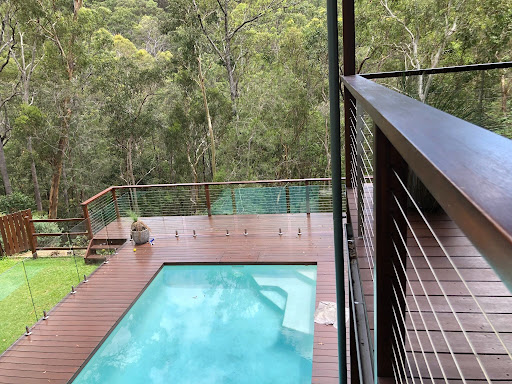
Balustrade in Australia must comply with safety standards and that is not a matter of choice only; the standards have just been made more stringent with the 2026 edition of the code. If you are constructing a deck, changing a pool fence, or designing a commercial staircase, getting balustrade heights will be more difficult for you if inspections fail, you have to do costly rectifications, and there is the real risk of you being liable.
Wire balustrade regulations are mainly based on the National Construction Code (NCC), Australian Standards, and local council requirements. If you overlook any one of them your work will stop. Miami Stainless is a supplier of stainless steel balustrade systems that are compliant, marine-grade, and trusted by builders, architects, and individual owners throughout Australia. Below you will find the main things you need to know for 2026.
Reasons for the Increasing Importance of Wire Balustrade Compliance
NCC 2026 requires the prevention of falls and the structural performance of facilities such as stairs, balconies, and outdoor living areas to be reconsidered.
Municipalities in Queensland, New South Wales, Victoria, and Western Australia are not only willing to check your documents but are also physically checking items at the stage of inspections. If you spend big bucks on a certificate of occupancy and then find out your balustrade is non-compliant and you have to retrofit it, that will be pretty expensive. The first time winning is the only solution with such matters.
Major NCC 2026 Balustrade Height Requirements
Residential Decks and Balconies
The following are the minimum heights for balustrades as per NCC 2026 Volume Two:
- 1m to 4m above ground: Minimum 1000mm height
- Above 4m: Minimum 1000mm with increased structural loading requirements
- Stair handrails: Must sit between 865mm and 1000mm above the stair nosing line
All dimensions in this article are from finished floor level to the top of the railing or capping.
Commercial Buildings
As per NCC 2026 Volume One:
- At least 1000mm in standard accessible areas
- 1200mm minimum where the risk of falling is >4m in public spaces
- AS 1657 compliance for industrial and commercial walkways
Consult AS 1170.1 for the determination of wire tension loads and spacing of posts.
Pool Fencing
Pool fences must be AS 1926.1-2012 and state-approved and therefore the main stipulations are:
- Minimum 1200mm fence height to the top of the barrier
- Maximum 100mm spacing between vertical elements, incl wire balustrade
- Non-climbable zones (NCZ) — 900mm clear of any horizontal element outside
- No horizontal elements between 150mm and 900mm from ground which could offer a foothold
The horizontal wire configurations most probably fail the NCZ test. Vertical wire configurations may be acceptable but confirm always with your local council prior to installation.
Some Things that Builders Usually Fall Short on
Wire Spacing and Tensioning
The code says the infill gaps should not exceed 125mm – that means a 125mm sphere shouldn’t be able to pass through the balustrade, even when the balustrade is subjected to lateral loads. Wire that is not tensioned properly will hang down and will not pass the inspection.
Balustrades from Miami Stainless that offer tensioning without the use of tools are a reality with the swageless wire balustrade systems. Typically, for post spacing with 3.2mm 316 stainless steel wire rope may be 1000mm to 1200mm — the closer spacing will give a better deflection performance.
Inspection Fails Due to Most Common Errors
Using the subfloor as a starting measuring point is wrong, finished floor level should always be the point down from which you take your measurements.
Posts are too far apart — 3.2mm wire spaced beyond 1200mm often fails the loading test of the deflection. Reduce the post spacing or use a thicker wire.
304 stainless steel use near the beach — the NCC requires that within 1km from the beach the stainless steel be of marine grade 316 level. The 304 grade is prone to rusting in salt-air environments and will not be in a funder with the NCC and Australian standards for coastal installations.
Taking it for granted that the wire is approved for pool fencing — always ensure you check the arrangement against AS 1926.1 and get it approved by your council first.
The Best Miami Stainless Products to Get You Through NCC 2026 Compliance
If you want your balustrade system to be fully compliant we can supply everything – wire, terminals, posts, handrail fittings; all in 316 marine-grade stainless steel.
Recommended Products
316 Stainless Steel Wire Rope — 3.2mm and 4mm wires are in stock. Marine-grade 316 is the standard for both residential and coastal balustrade applications.
Swageless Wire Balustrade Systems — You can tension the field without requiring a hydraulics swage press, or hand swaging tool. It is the right choice for builders and renovators who want a clean, compliant outcome but have very few tools available.
Pre-Swaged Wire Balustrade — The factory has assembled two standard bay lengths. Pre swaged wire balustrade shortens the time for installation and it provides all terminal hardware.
Stainless Steel Posts and Handrail Fittings — material of 316 grade round and square balustrade posts matched with stainless handrail end caps, adjustable handrail joiners, handrail fittings are all for complete compliant assemblies.
Check out the complete wire balustrade collection and download technical specs from the catalogue and resources section.
Get It Right — Contact Miami Stainless
Is this new construction, deck renovation, or a commercial project? Miami Stainless has the components and up-to-date compliance knowledge that will give you a pass at your inspection the first time without any hassles. The team collaborates regularly with homeowners, builders, architects, and specifiers across Australia.
Log on to our website to check out the products and submit your quotation request
Frequently Asked Questions
Q1. What are the minimum wire balustrade height requirements under NCC 2026?
According to NCC 2026, residential decks and balconies that are above 1m from the ground require a minimum height of 1000mm for the balustrade, with the measurement being taken from the finished floor level to the top of the handrail. In the case of commercial spaces above 4m, the height may be required to be 1200mm. It is always good to double-check with your local council or building certifier to confirm the details before you begin work.
Q2. Do wire balustrade regulations allow wire fencing around swimming pools?
Wire balustrade can be designed in a way that it can be close to pools but meeting the requirements of AS 1926.1-2012 is a must. Usually, horizontally running wire types do not meet the non-climbable zone test. There can be vertical arrangements that can be allowed under some conditions. Confirm gates, the wire spacing and NCZ requirement elements with your council before finalising the design.
Q3. What wire diameter is necessary for compliant wire balustrade in Australia?
The most frequent finishing for local residential stainless steel balustrades is 3.2mm 316 stainless steel wire rope. To trap movement and keep it within the 125mm sphere limit, post spacing should be continuous at 1000–1200mm. When wider post spacing is used or there is a higher load, 4mm wire rope can be used to provide stiffness and performance.
Q4. What grade of stainless steel is necessary for coastal balustrade installations?
Grade 316 marine-grade stainless steel is imperative for all balustrade components that are within 1km of the coastline. Grade 304 will not survive the high salt-air condition. Miami Stainless is a provider of 316 wire, fittings, posts, and terminals — that can face the worst of Australia’s coastal conditions while keeping wire balustrade regulations intact.
Q5. Can I self-install a swageless wire balustrade and still pass inspection?
Basically, yes — if installed the right way. Miami Stainless swageless wire systems do not require a specialist swaging tool. Yet, if they are tensioned and spaced according to specifications the systems meet wire balustrade regulations under the NCC. Remember to always arrange to have a licensed certifier inspect the completed installation prior to your application for the occupancy certificate